
Why Is 10mm Straight Polypropylene Fiber a Reliable Choice for Everyday Concrete Work?
The truth is that all projects do not require a well-engineered fiber designed for structural applications. What some contractors need is a simple and reliable fiber that will control plastic shrinkage cracking without overcomplicating the concrete mixture. That’s exactly the gap 10mm straight polypropylene fiber fills, and it’s one of the most consistently ordered products in our range as a PP Fiber Manufacturer.
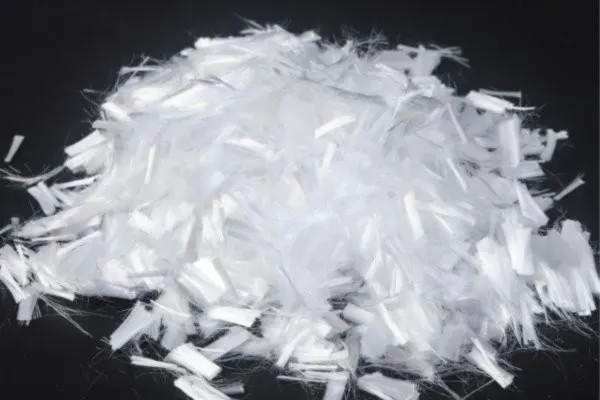
As the name suggests, this fiber has a straight, uncrimped filament structure rather than the twisted or textured profiles used in our multifilament range.
That simplicity is actually the point — straight fiber disperses cleanly through the mix, doesn’t ball up during mixing, and provides even, predictable crack-control performance across the full depth of a slab or plaster coat.
Product Overview
Manufactured from virgin PP micro fiber raw material, our 10mm straight fiber goes through the same rigorous extrusion and quality control process as the rest of our range. As a dependable PP Micro Fiber Manufacturer, we cut every batch to a consistent 10mm length, which strikes a practical balance — long enough to provide meaningful crack-bridging capacity, short enough to stay easy to mix and finish without affecting surface texture.
Technical Specifications
| Fiber Structure | Straight |
| Brand | Fiberwell |
| Alkali Resistance | Standard |
| Fiber Length | 10 mm |
| Tensile Strength | 547 MPa |
| Melting Point | 165°C |
| Size Classification | Macro |
| Density | 0.91 g/cm³ |
Key Features
The straight filament design means this fiber mixes in cleanly without the clumping risk that some twisted or crimped fibers can introduce at higher dosages. It’s corrosion-proof by nature, which makes it a solid alternative wherever contractors are trying to avoid the long-term rust-driven cracking associated with steel mesh — a real concern for any Concrete Reinforcement Fiber Manufacturer serving humid or coastal regions. It’s also lightweight enough that it doesn’t add meaningful dead load to the structure, and it holds
up well against the alkaline environment inside curing concrete without degrading over time.
Recommended Dosage
For general-purpose plastic shrinkage crack control in slabs, screeds, and plaster, a dosage of roughly 0.6–0.9 kg per cubic meter of concrete typically does the job. Projects with higher shrinkage risk — hot-weather concreting or thin-section slabs, for example — may benefit from dosages up to 1 kg per cubic meter. As always, we’d recommend confirming exact figures with our technical team, since local aggregate quality and curing conditions can shift the ideal dosage slightly.
Mixing Compatibility
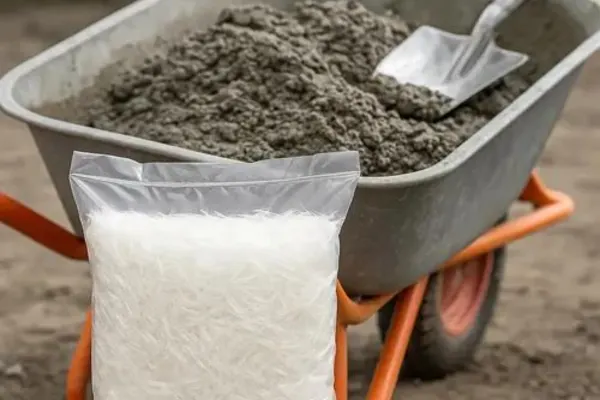
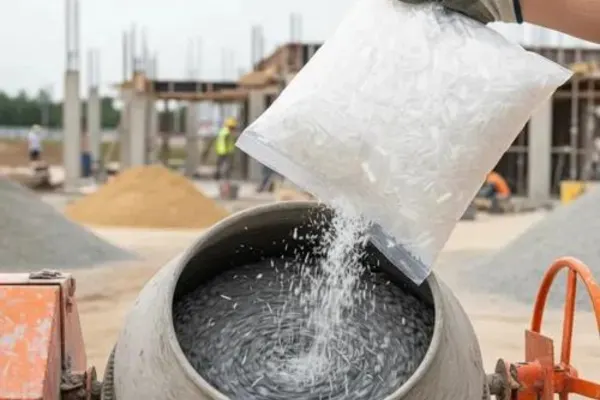
The fiber is suitable for use in ready-mix batching plants, site mixed concrete, and hand mixed mortar for plastering. It does not require prior soaking or dispersion through any specialized equipment prior to its use in the mixer, and it is possible to use it in concrete along with several other additives such as water-reducers without facing any ill effects.
FAQ
Is 10mm straight fiber suitable for plaster applications, or only for slabs?
It works well for both — its straight profile makes it easy to trowel into plaster finishes while still providing effective shrinkage crack control in slab work.
How is straight fiber different from twisted or crimped polypropylene fiber?
Straight fiber has a smooth, uncrimped profile that disperses more predictably at lower dosages, while twisted or crimped variants offer stronger mechanical bonding, which suits slightly higher-stress applications.
Will this fiber show on the finished concrete or plaster surface?
At recommended dosage levels, fiber strands are generally not visible on a properly finished surface, though very high dosages or poor finishing technique can sometimes cause minor surface fuzzing.
For technical data sheets, dosage recommendations, or bulk order details, get in touch through our enquiry page or visit fiberwellindia.com.