
When Should You Choose 12mm Monofilament Polypropylene Fiber Over Shorter Variants?
At 12mm, we’re at the longer end of our monofilament range, and length here isn’t just a number it changes what the fiber is actually good at. Shorter fibers excel at fine shrinkage control near the surface, but 12mm monofilament fiber bridges cracks across a greater depth of concrete, making it a better fit for slabs, pavements, and industrial flooring where the concern isn’t just surface cracking but crack propagation through the full section. As a PP Fiber Manufacturer, this is one of the sizes we recommend most often when a project sits right on the edge between basic shrinkage control and something closer to structural-grade reinforcement.
Because it’s monofilament rather than multifilament, it retains the smooth, single-strand dispersion characteristics that make mixing predictable, while the added length gives it more reach across a crack as it tries to form.
Product Overview
We produce this fiber using virgin PP micro fiber, maintaining the same diameter and length consistency across every batch that our full range is built on. As a specialized PP Micro Fiber Manufacturer, we pay particular attention to filament straightness at this longer length, since any curling or inconsistency becomes more noticeable — and more likely to affect dispersion — the longer the fiber gets.
Technical Specifications
| Fiber Structure | Monofilament |
| Brand | Fiberwell |
| Alkali Resistance | Standard |
| Fiber Length | 12 mm |
| Tensile Strength | 600 MPa |
| Melting Point | 160°C |
| Size Classification | Macro |
| Density | 0.9 g/cm3 |
Key Features
The added length gives this fiber a genuine edge in slabs and flooring where cracks tend to develop deeper into the section, not just at the surface. It still disperses evenly thanks to the monofilament design, so there’s no clumping concern even at the higher end of the recommended dosage range. Being fully non-metallic and alkali-resistant, it also removes any long-term corrosion risk, which matters in industrial flooring exposed to moisture or in any application where a Concrete Reinforcement Fiber Manufacturer alternative to wire mesh is being considered.
Recommended Dosage
For slabs and general flooring applications, 0.9–1.2 kg per cubic meter is typically recommended. For industrial flooring or pavement work with higher shrinkage and load exposure, dosage can go up to around 1.5 kg per cubic meter. As with all our fiber products, exact quantities should be confirmed with our technical team based on your specific mix design and application.
Mixing Compatibility
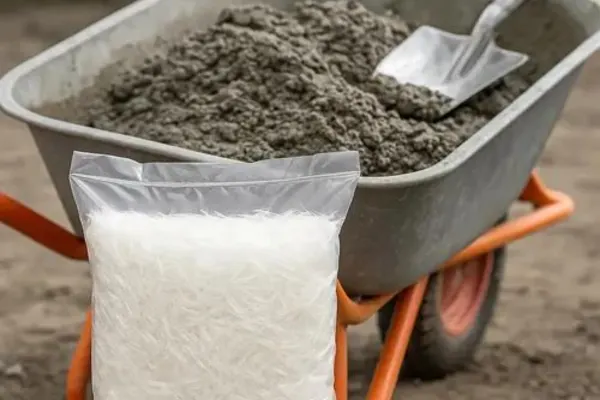
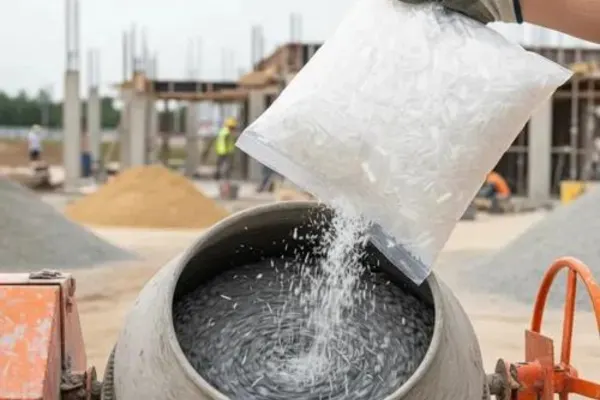
Mixes cleanly into ready-mix concrete, site-batched concrete, and precast mixes. No special dispersal equipment is required, and it works well alongside common admixtures such as plasticizers, accelerators, and curing compounds.
FAQ
Is 12mm monofilament fiber better than 12mm multifilament fiber?
Not necessarily better — they suit different needs. Multifilament offers stronger mechanical bonding due to its twisted structure, while monofilament disperses more predictably and is often chosen when uniform crack control matters more than maximum bond strength.
Can this fiber be used in industrial flooring projects?
Yes, its longer length makes it well suited for industrial flooring, where crack resistance is needed through a greater depth of the slab, not just at the surface.
Does the longer fiber length affect surface finish?
At recommended dosages, surface finish remains largely unaffected, though very high dosages in thin sections can occasionally cause minor fiber show-through.
Need dosage guidance for a slab or flooring project? Reach out through our enquiry page or check the full range at fiberwellindia.com.